
‘What can I do to improve my running technique?’
This is a question that I get asked all the time.
A simple and quick answer is that you already have a better running technique – you use it when you run faster / sprint.
Sprinting is a much more efficient form of movement and while we can’t maintain the speed for long distance we can maintain the posture and the control of motion at a lower pace.
Therefore
Step 1 to improved Running Technique – is to compare your sprinting form to your normal pace form
What to look for is
- Posture – Spine Shape & position relative to pelvis and head. Are you more rounded across the shoulders when running Slower? Have you got an increased Lower Back Curvature when running slower?
- Forward Lean – do you stand more upright when running slower?
- Alignment – The relationship between your hips – knees – feet when you land may be different. Also you may find that the hip shifts out to the side when you run slower which is a sign of a lazy swing phase and not being ready when you hit the ground on your next step or it may be an inherent weakness in your stability strength
- Amount of upper body movement including arm motion may change when you change pace.
- Landing position of the body relative to the foot. i usually find the foot strike position relative to the body is better in the faster pace and a change and for the worse can be a lazy habit developed over time due to weakness and poor skill practice
This is not a full list but it would give an insight into what may be your main running issues causing pain or poor performance.
The easiest way to do this comparison is to do the running on a treadmill though I’m not really a fan of treadmills. Ideally a camera used outside to capture your normal running would be better. if you set up a camera at a track that captures you on the straight with a view of at least 3 full strides should be enough to get a good reading. try to get a side view and a view from behind.
Step 2 Implement Training Changes
Based on the finding from step 1 you need to address why your running form changes.
Mostly I find that its a combination of poor strength and accessory training to build a good running foundation and a lack of training the running skills displayed when sprinting.
One very common problem I see is the 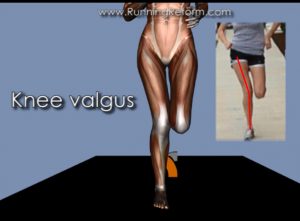
Knees drop inwards on landing causing Knee Valgus. This is all too often blamed on foot pronation but 2 things to remember here are
a. if the hip and pelvis stability is poor then foot pronation has to happen to compensate
b. if you have a lazy swing phase and the leg is not prepped for landing and the deceleration / braking forces that occur then the foot is over loaded and forced into pronation
If you show increased knee valgus when running slower then this is not foot pronation in action.
For this type of problem what i advise is to improve your deceleration control with deceleration training (see video below).
Step 3 Practice your new strength
Following this development I would also get my athletes to run drills that start with a sprint and then slow to their race pace aiming to maintain their running form.
This may need some coaching to get it right but ideally running form should change organically rather than be forced with too many technique cues so slowing your natural technique reduces the need for over coaching.
This type of session should be a weekly occurrence starting with a 10 x 200m repeat format with the 200m made up of
30m sprint slowing over 20m to 150m of race pace
We can lengthen these sessions to 10 x 500 m meaning we aim at being able to maintain our new form for 5km
Once we can do the 10 x 500 session then we work on the reducing the breaks with 5 x 1km sessions and so on to the full 5km
We can also incorporate some of the deceleration work into our daily or pre run warm up
When all of this is done and you have a better 5km time than ever before then we repeat the process and from step 1 again and see what other issues we can address or we tailor the training for longer distances etc,
For more info contact me about a Running Analysis Session or an online video submission assessment