
Prevent Injuries and Perform Better With Improved Mobility
In spite of all the health benefits from an active lifestyle, why do so many athletes get niggles and injuries?
Is running (and other sports) worse for us as we age?
Few, if any runners, avoid injuries all the time.
So whats the best way to prevent niggles and injuries, train pain free and perform better?
Two great ways to help yourself are
- Ensure you do your mobility training
- Track and record the quality of your recovery
Mobility training and how much I need to do is not yet a perfect “science” in my mind. It’s more of a trial and error exercise to begin with to find what works for you.
Some people might get away with no warmups, cool downs and stretch, but the majority of people would benefit from consistent mobility work.
I work off the R7 approach where I try to incorporate all aspects of performance into each training session.
Its easier than it sounds as a worm up and primers for power and strength can be done in as little as 15-17 mins. This is followed by the bulk of the conditioning work (running) and a cool down.
Added to this I would generally do a 10min TRX Mobility routine 5 out of 7 mornings per week.
| TRX Corkscrew |
| TRX Lower Body Seperation |
| TRX Back Swing |
| TRX Full Swing Control |
Mobility work isn’t only about not getting hurt. Poor movement patterns and weaknesses mean we are missing out on optimal performance too.
SO incorporating a mobility plan into your training doesnt have to be hugely time consuming.
Tracking your recovery
Every marathon plan or 10k performance plan I’ve come across over the years has had a long run or tempo run or race pace run in it each, i.e. a hard session on the body. Sometimes more than one per week!!
The general advice is that training sessions are laid out in a Hard – Easy – Hard format allowing a bit of recovery after the hard sessions
But could this be done better
I would argue that it can and easily too.
A great way is using a TQR scale or a Total Quality Recovery Scale to be precise. Its simple but over time it can give you an insight into whats your best recovery routine.
Below is a shortened copy of a TQR scale I send to my athletes daily via the Athlete Monitoring App. The player records their score and submits it on their phone
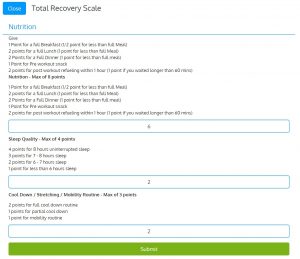
Basically anything over 11 and you’re all but fully recovered and ready for that days planned session
Between 9 and 11 and perhaps you should ease off on the planned intensity that day
Below 9 and I’d probably advise taking an active rest day with recovery consisting of mobility work / swimming and possibly massage etc. if possible.
Over time if we track your daily recovery scores versus your daily training loads and performance levels we can see if we can manage the training loads better by spacing out the harder sessions or putting them in on days of the week which may suit better.
A longer TQR scale can also include stress levels heart rate and health tracking but the above is a very easy starting point for every athlete at any level but the benefits can be significant when tracked over a period of time