
It is as its always been – everyone wants to win!!!
Coaches, players and parents all want to win.
It’s not right or wrong in my view, I’m the same and I see it in my little boys at home as well all the young players I help to coach.

Kids love competition even from an early age. I see 3 – 6 year olds who just want to be first at everything.
This competitiveness and drive is something that coaches would love to bottle and hand it out to players as they get older and start playing more formalized competition.
The problem is we cant and we have to find ways around that to make our teams more competitive.
So what happens is we see what older teams or even professional teams are doing and we replicate that at younger ages. In the US Kids as young as 8 have been put on weights programs to help develop them towards the NFL.
The NFL and American football as a whole could stand up a model to avoid when contemplating underage sport. Apart from the concussion and brain injury issues that have grabbed the headlines, only a minuscule number play the sport into their adulthood. If you don’t get drafted into a college program at the end of high school then that’s you done.
By the way I love watching the NFL. I spend most Sunday evenings watching the Redzone on Sky Sports.
But I worry that the win at all costs culture that has sprouted into a commercial juggernaut that places kids under unfathomable physical and mental strain is being slowly copied in other sports. I hope I’m wrong.
In clinic I see more and more kids with soft tissue injury and while we could blame multiple factors the fact is most soft tissue injuries are caused by the THE TERRIBLE TOOS
Too much, Too often, Too fast, Too soon or even Too little
Elite sport has recognised this and have Player Management Systems in place to track and monitor how much work they do. This has led to bigger squads and player rotation but injury levels have dropped because of it.
Ireland is a global leader in the Athlete management industry with companies such as Statsports, Kitman Labs and Metrifit.
While these companies don’t necessarily cater for individual players that a parent can reasonably afford there are options so isn’t it time we start putting some of this knowledge into our development systems.
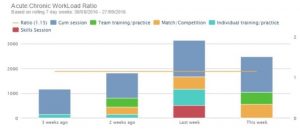
Above is a table outlining the amount of training and matches that a player has from week to week.
The Acute: Chronic Ratio is the amount of work done in any week relative to the previous 4 weeks.
The guideline for any increase is 15% extra compared to previous week. So in week 3 when a skills session and match were added then the gym session should have been dropped or at the very least cut down.
And remember this doesn’t take into account school work and other stress factors!!!
The above example is fairly in depth but to begin with we don’t need to be overly reliant on technology or measuring equipment.
A tried and proven method is done using Arbitrary Units (AU) and the RPE Scale (Rate of Perceived Exertion)
Basically we can get the player or athlete to rate how hard they felt each session was out of 10. 1 being very easy and 10 being almost impossible. i.e. 1 is a simple walking effort / jog while 10 is repeated flat out sprinting.
We then take the effort and multiply it by the amount of mins the session lasted. e.g. 60 minutes for a match.
So if the RPE was 7 and the match was 60 then the AU score would 7 x 60 = 420
So what do we do with this score?
Well this is the score that we keep track of and over the course of the week we add all the scores from all the training sessions and get an average score for the week which is your weekly average load
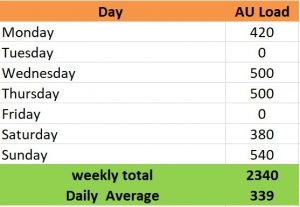
Over 4 weeks we can get a baseline weekly average which for example maybe 2500 AU with an average daily Average of 550 AU – Daily depends amount of training sessions per week as well as days per week.
This is the total amount per day and week that we should not exceed too often or by too much.
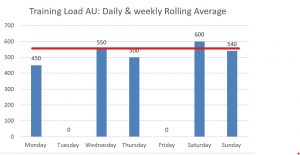
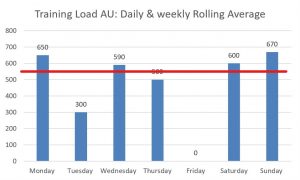
In the example above the player exceeded his daily average only once that week so no over-training has occurred.
However in the across on the right the player exceeded the daily average 4 times and after Saturdays match / training they had exceeded their weekly load as well.
In this instance you have to ask if the player could have managed the weekly load better earlier in the week or if they should have been allowed to play on the Sunday at all?
Consistent overload will inevitably lead to injuries so monitoring training load as well as stress and fatigue is something that coaches and parents should consider.
The examples above are very basic for information purposes only but an effective training load management spreadsheet can be downloaded at Science For Sport
Or contact me directly for info on the Optimal Biomechanics Training Load Testing and Monitoring Service