
Sciatica is a common type of pain which impacts the sciatic nerve as it extends down the leg.
The term Sciatica is a “catch all” term which describes a particular subset of symptoms including:
- Low back pain
- Hip pain in the back of the leg which is generally worse during sitting
- Burning or Tingling down the leg
- Weakness or numbness in the foot
- Constant pain in the rear
- Shooting pain down the leg
The problem with the term sciatica is that it is a name for these particular set of symptoms but it isn’t a diagnosis for what is actually causing the symptoms.
It is important to least establish a working assumption of the cause / where the symptoms originate from in order to effectively treat it.
The first thing we need to clear is the lower back.
This is a where the sciatic nerve originates and as a result it makes sense to start here because if you miss the low back as a pain contributor, any other treatment will have minimal or temporary impact.
Low Back
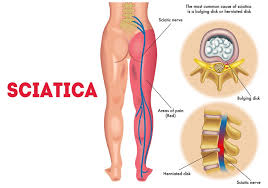 The first thing to look for is a directional preference of the spine into either flexion or extension? Do you hold your spine in a forward or backward bend?
Are the symptoms provoked with compression – pain kicks up a notch when you rotate and / or bend to the side of the pain?
Are symptoms alleviated with distraction – rotating and or side bending away from the pain side?
What positions are the symptoms worse in – sitting, standing, or walking? Disc driven sciatic pain is usually worse when sitting?
Is there associated muscle testing weakness of the leg that presents asymmetrically?
What was the mechanism of injury? Bending , twisting and lifting?
These are all important considerations for low back contribution to sciatica symptoms. They also help you understand what movements you should avoid early in the rehab!
Hip
Many people tend to refer to this one as piriformis syndrome. However, the piriformis sometimes takes a lot of unnecessary blame. When we look at the hip as a pain source it is because it can irritate the sciatic nerve.
Nerves like 3 things – blood flow, space, and movement. All joints and soft tissues do!!
Think about the last time your arm fell asleep when you had it resting over your head. The arm was on stretch overhead, thus restricting space as well as blood flow and it was not moving. Which is why you started to experience tingling in the hand.
It’s no different than sitting on a hard chair for a long period of time. At some point you need to shift PRESSURE to the other butt cheek.
When looking at the hip, we want to see how much range of motion an individual has into both internal . Before we try to stretch anything, we should consider if the total Rotation range of motion at the hip is ~ 90 – 100 degrees (That’s external rotation (ER) and internal rotation (IR) combined). If you can reach this total range of motion number, then more than likely its not a flexibility issue.
What you may notice is that you may have a a tendency to utilize more ER or IR at the hip (in most cases people will have more ER than IR). If this is the case, then you may need to consider lengthening the internal rotators while strengthening the external rotators.
Finally, there is also a certain subset of people who have excessive hip range of motion. In these instances, it appears that the muscles create protective tension in order to help the joint feel more stable. As a result, the way to decrease the constant resting tension is to actually strengthen both the hip IR and ER musculature in order to provide an improved control.
Sciatic Nerve
Finally the nerve itself. After an injury, or if symptoms are experienced for a prolonged period of time, the nerve can become highly sensitive/symptomatic to pressure or tension. Basically any level stimulus sets off pain responses.
At this point in time, neural tensioners /sliders or flossing (See video) can be a useful mechanism to gradually expose the nerve to tension and compression to create an increased buffer zone from symptoms occurring in the first place.
Summary
Now you understand why it’s so important to always have a clear idea of where the pain is coming from. Generally speaking its best to clear the back FIRST while simultaneously start treating the symptoms further down the chain.